


1. Solemn or burlesque
In the Romanian rural ethnographic documentation of customary popular ceremoniality, we have been able to document both carnivals and carnivalesque behaviour, distinctly, in the frames of the research fostered by Orma Sodalitas Anthropologica. We have thus called such manifestations carnivalesque behaviour and have identified it within or without classical carnival situations, in the forms of un-serious, burlesque, satirical, or quiddity conduct, strewnwith puns and quibbles. They can entail masking, but the actual hiding of one’s identity behind a physical mask is not the defining feature of this particularly articulated behaviour. What stands out and distinguishes it clearly in the ensemble of festive/festival/ceremonial behaviour, is a certain, constant, incessant, permanent passage, from solemnly wearing a particular mask, which is equivalent to actually becoming that respective mask, and the subsequent transformation of the readily masked character, into their burlesque counterpart.
What kind of description frames this process best? To the field ethnographer, it means to witness the unfolding of a screenplay, with an unknown script: regardless of the amount of scientific literature virtually dedicated to the description of the custom, it would be abusive for the outsider field-researcher to imply that s/he might know full well the script of the play, enacted in the course of the custom. Moreover, it would be methodologically wrong to ‘judge’ the performance of the actors/characters in accordance to this template, and not in accordance to the narrative embodied and transmitted by the local performers, which may change with every new incidence of the custom (usually on a yearly basis). That there shall be an amount of constancy, of necessity of transmission of certain traits, this is nevertheless true, and we have devoted always specific attention to what and how is being transmitted (from Benga 2005, to the present), in folklore, cultural, and celebratory terms. If any direct field observation is to be issued, I would opt for noticing that, for the performers/actors/agents, embodying characters –be it through masking, or through mere interpretation of roles– results first and foremost in a hieratic implication. Hieraticism rules the roles in the screenplay: whether they embody a green man or a goat, people behind the mask feel not downplayed, but raised to a modified status, be it confined to the temporality of the performance of the custom.
If we admit people step into the screenplay of customary celebrations by means of ritual/ritualized behaviour, then we need to admit that it is ritualized behaviour to elicit it all: the enactment of the screenplay, and also the suitable performers in the know of their roles –and, ultimately, the respect for their confinement to their role. It so follows that ritualized territory of behaviour is what calls for the enactment: not only of masking, but also, of the entire modified personae of the embodied characters wearing the masks and the roles altogether. And “ritualized” means formal, in a certain sense, that is, structure and order. For when we speak of ritualized disorder, that too has its own confinements (Eliade 1949: 18-19 and 20, Burke 1978: 187-192): temporal, above all, and within the role (mostly, that of the carnival). In my experience, the mere notion of formalism, or of ritualization, implies entering the hieratic, solemn, dimension, for I have never encountered a formal, ritualized, completely burlesque/carnivalesque role-bound behaviour. When it does become formalized, then it must have entered the hieratic realm. That is how the bearers of the customs I have been able to witness and document have framed their own performance. Outside of this box, individuals may well produce behaviour, yet, we would have difficulties to demonstrate their actions belonged to folklore.
As a masked character, the mask-carrier –we are generally told, in the literature devoted to carnival masking– can do virtually anything; but, if checked with care (item with item along the ethnography), anything is actually of poor variation, albeit rich in spontaneity. The main themes in the hieratic cluster, are turned up-side-down, through mockery, in the carnivalesque. Interchange between the two is actually the main source of “fun”, for both the performers and their audience. Is there, therefore, any grounds for stating an anteriority of the hieratic, as compared to the burlesque? To measure such a chronology, we need to look at ethnographic facts. That most carnivals across the European countryside mimic and mock important community events, such as funerals or weddings or birthing (Burke 1978: 122-124 and 178), does not say that there is a chrono-topic failure between the interpretation of the two, in the conscience of the people inside the respective community; yet, is there any carnival representing events that do not pre-exist, formalized and ritualized, at the community level? My personal field-researcher’s answer being no, my conclusion thus far is that carnivalesque mockery does not create hilarious situations, mockable because of their inherent flaws. On the contrary, carnivalesque mockery can only exist where there has been serious ceremoniality, shared and expressed inside the community, prior to the burlesque event (cf. Neagota 2019: 73-76).
In order to follow the argument, we need to present a few popular celebrations, of the kind we have been able to document in the Romanian rural ethnographic field. For that reason, they are representative for our group expertise, and less so for the general radiography of all extant document surviving about feasting while wearing a mask. Further effort is due for analysing exclusively archival material.
2. Ceremonials with masks
Masking and their role within carnivals has been extensively analysed and described countless times. Yet, carnivalesque masking is at the weaker end of the greater mask-bearing and ritualized disguise, in a number of popular ceremonials. Among them, I shall focus here on masking as constitutive part of some calendrical ceremonials, observed by their bearers as popular customs, up to the present. They are: the Green Man/Sângeorz, the Adorned Ox/Boul Împănat, and the Căluș. They present themselves, to the contemporary eye, as composite, albeit archaic, structures/screenplays, while the mask within holds a dominant: humanized vegetal, humanized animal, and mock human, respectively. All these masks are, along the performance of the custom, successively: created, enclothed, worn, embodied, dwelled, acted, then: undressed, discarded, forlorn, and, for the researcher, spoken about, afterwards.
Masks. The simplest mask is made of cinder blended with grease applied on places of exposed skin, usually on the face –since one core task of masking is to conceal the everyday identity for a definite amount of time, for a definite goal. The most detailed mask can be obtained the way mortuary masks used to be built, plaster applied directly on the dead figure. These two extremes represent also the two tangent points between the bearer and their mask; in between these extremes, there lay infinite ways to build a face, the head of a character, most times (in my contemporary Romanian field experience) envisaging a mammalian, even though an imaginary one. All bearers are switching identities, from mundane to fictitious, formal, ritualized, by means of ”being worn” at their turn, by the identity figured by the mask. They thus enter their respective roles, playing them, more or less spontaneously. Yet, no matter the script, human bearers, fully human in character, are going to keep being just the mere mannequins, for the identity enclothed together with the mask.
Roles. The main question, for the folklorist seeking to unlock as much as possible of the information transmitted by the rural popular custom, remains: what is one’s ”job description” as a mask? Masking entails a change in one’s assumed and represented identity: but one that lasts only as long as masking remains in place. And masking is coherent, rational, community-relevant, only as long as it tells a community-relevant story. Had the story been solely individually-relevant, how could it mean anything for the audience of the spectacle displayed with the help of the masking procedure? Misunderstanding, fear, distance, power unbalance, all of that, and more, would drive the audience on the wrong path. Additionally, because of the presence of one, or more, often fully mute masks, performing in an un-shared screenplay, would probably make us miss the narrative, the script intended-to-be-told. Yet this does not happen: one decisive trait of folklore lies in its quality of transmitted, shared, content. In the following lines, we will to follow the engagement between the masked, and the audience of the custom-with-mask: the interaction, the negotiation –mitigation– eventual correction, the dramaturgical display, the narrative of the script, the effect of the narrative units on a given audience.
Script. To look for truth in tales told dramaturgically, is of paramount relevance in ethnology and fields akin; yet, as stated elsewhere (Benga 2009, Benga and Neagota 2010), the message is not in the plot, or not solely in the plot. Functionalist interpretation of popular plays, dramas, and ceremonials, which all entail some kind of masking, is both valid and invalid. For example, it is not enough to interpret a play with propitiatory functions (Oprișan 1981: 270-271), to actually bring propitiation to the community; at the very least, what is also necessary, are the firm beliefs of people in the community, in the capacity of the ritual group, virtually masked, and in the quality of the ritual group, to bring propitiation, prosperity and sheer goodness inside the community. This conviction (or “credition”) (1) can only be kept alive, generation after generation, by means of cultural transmission and epigenetic, even, transmission. This virtue of being a harbinger of goodness seems to be confined to the solemn dramaturgy; yet similarly, it seems, have things assembled in the burlesque counterpart. Equally explicit in the field documents (the Green Man in Muncel 2024, researched on the twentieth year of surveillance by I. Benga and B. Neagota), a spectator is being told that enduringcharivarias a victim, does transmit a lot more (2) than the contempt it seems to entail (Neagota and others 2017). In one word, the dramaturgic scenario in itself is not enough a reason to foster a concept of definite hieraticism, versus one of a definite display of contempt. The two may well be combined (as stated in the beginning), yet, if asked, villagers are to opt for the overall solemn dominant of their actions assembled in the ceremonial, when depicting them in recollection.
Green Man. We tend to cluster the Green Men in the vegetal mask category, considering the reality of their mere construction: using vegetal fibres, tree foliage, hay, tree bark –for covering the body parts of the person wearing the mask; wooden skeleton– for the masks the person enclothes and dresses in; wooden poles, sculptured wooden body parts –that come attached to the mask which is worn, in sign of special attributes to be used during the performance of the role assigned to the mask (phallus, horns, tail –hyperbolised, or imaginary); wooden ad-hoc musical instruments to accompany the script (primitive flutes in all sizes made from hazelnut tree bark, etc.). For all these attributes, we have been clustering this mask under the label of humanized vegetal, even though the human bearer dressed in vegetal fibres may wear green vegetal horns and tail. Is the resulting mask embodying a man, or an animal, or a walking tree? To attempt to answer, we need to follow these masks inside the ceremonials they dwell, allowing us to virtually discover a combined, and therefore fantastic, status. Wearing the respective status with the mask can never be either easy or in joke, which explains the exclusively hieratic behaviour of the character per se –with carnivalesque features adjoined later in the chronology of the traditional custom (3). To that end, a multiplication in number of the same kind of green men at a given celebration gives way to a complication of the screenplay, and that, surely, can improvise endlessly in one and only direction: the carnivalesque.
The modal custom at St. George’s holds primarily an agricultural-pastoral significance, meant as it is to bring a good yield in cereals and milk. Common elements uniting known variants entail: the collection of the vegetal, foliage and bark, in the woods, by the members in the group of youth (plus some older, married men, who may help with the creation of the costume-mask) on the eve of St. George; the election of one of them, strong enough to carry the heavy costume; the enclothing of the character with the vegetal elements of the mask, a person who gradually becomes, at the moment of the beginning of the specific procession throughout the village, the green man; companions create musical instruments –flutes, of many kinds– from branch peel, and/or are joined by the fiddlers from the village feasts; along the village, they carol through-in and throughout every household; the host of the household is pouring at least a bucket of water on the Green Man, goodness starting to flow if there is payment too (eggs, bacon, money, alcohol); along the way, anyone may toss water on the masked character, while he is protecting himself with the pole (4) or is protected by lads/men specially prepared to that; village carolling once over, the entire cortège is reaching a place outside – flowing water, or source of water for livestock, or among the cornfields, where they disassemble the mask, undressing him of the vegetal costume (5).
Not entirely green. Variants do continue to yield dramaturgical formats spanning many decades of mention in the sources, showing a complicated story: characters are strictly divided, by their aspect and behaviour in the economy of the custom. Always in the mention of Traian Gherman (1986: 109-110), the Green Man/Sângeorz is a harbinger of goodness, yet, he is made acting its role together/in the company of antagonistic figures: the other masks: Goțoi, Droanga, Draci. In the same source, the figure “Goțoi” denominated an evil spirit, dangerous for both households and crops; as a mask, his face is covered in embers and the body in rags; he protects the Sângeorz from being watered, which makes him an integral, necessary part of the Green Man script: mana, the goodness, depends on the people in the village watering the green-leaved figure (the humanized vegetal), to start to flow upon the household, cattle and crops, belonging to each and everyone in the village; yet, this is seen as the result of a fight, a wrestle; that is to say that the script entails a dramatized conflict, whose actors are two antagonistic fictional characters, embodied by their masks (Sângeorz + Goțoi), one a harbinger, the other an opponent, both masked characters, and the public, the audience, the village, who wants to get to the goodness, and that comes not easy (in villages: Florești, Codor,Vale, Căianu Mare, Căianu Mic –in Gherman 1986: 110). Old celebrations documented in villages Deleni and Hășdate (1910) foster threesome characters: one Goțoi, a green man yet with a sheep skin on the back and a sheep bell for a tail, wearing a pole with a ball of rags at the top, blackened on the face and hands, with greasy cinders; the Proud-the-wise, a mask embodying a she-green figure, and the Mute-the-dumb, a he, a couple walking ahead of the green cortege –with flutes– and yelling: “should you not water the Goțoi, there will be no harvest in the fields!”, while the Goțoi is trying to avoid being watered, hopping on all sides: if he succeeded to keep away from one bucket, only, the goodness of that failing villager would miss his household completely (Gherman 1986: 111). In villages Micești and Filea de Sus, two green men were called Muroi, intentionally designating dead spirits/the famous strigoi. Dressed in fresh foliage and armed with freshly cut wooden clubs, they were chased in a course by the villagers who wished to water them plentifully; were they not to be watered, they would be redeemed with a sum of money paid by the people, lest they lose the milk and the crop (Gherman 1986: 112).
Wrestling. The scenarios above show masks of predominantly a vegetal nature, with polarized behaviour, meant to suggest a rather complex script; to this script, Bogdan Neagota gives a historical-religious reading which sees the entire custom as being set in act by the group of young lads, formalised like a fully-fledged Männerbünde, with dramaturgical roles which oppose characters bringing the goodness (crops, milk, fertility) and characters pretending to prevent the harbingers to deliver their load, only to finally concede, one way or another (through either pay, or watering); this opposition mirrors another, between the group of youngsters and the professional mana-thieves, the strigoaie (Neagota 2011: 357-360, Neagota 2019: 84-86), one annulling, or proclaiming the end of the other (the real group eliminating, via the ritual, ceremonial, dramatized confrontation, the imaginary group).
Antagonizing. The dramaturgical setting is being kept, in most ways, in the case of the Adorned Oxen feast, usually held on Whitsunday. The solemn dimension is being challenged by the parallel procession, with full carnivalized counterpart, which gathers together masked characters of which probably at least some once had their own individuality, being sheltered in other positions along the ritual year. The hieratic procession is composed by the ox tenders –lads (almost always bachelors, appointed to the task), maidens, musicians– who all carol the village dressed in their best clothes (with identity markers clearly attached to the hieratic side, in both behaviour and costume they clad: the traditional costume made uniquely for the purpose). Behind this cortège, the carnivalesque figures roam the road of the village, as they have done the entire morning, while the wreath of the ox/en (where they adorn both oxen, paired to the yoke, yet only one bearing the chaplet/peana/ struțul/crucea/cununa boului) was being made. The entire custom and therefore every mask, are aptly described in the state-of-the-art study of Ioan R. Nicola in villages Pădurenii (1957), Căian (1939), Chintelnic (1968), and Mănăstirea (1967) (6). He also notices another apparent antagonism, salient by the Adorned Ox: in the variants where the group of girls are summoned to catch the ox by the horns (adorned with the flowery wreath), the lads, riding on horses, are doing their best to irritate the animal, so that the task of the girls becomes really dangerous (or “funny” –in Nicola 1982: 571, note 43). Overall, this latter antagonism is easily readable through the premarital, nuptial, initiatory rites and rituals (cf. Neagota 2011). To that, the arguments Nicola brings from the past are very convincing, all the more as they are dated in 1939 (in villages Căianu Mare and Căianu Mic) and in 1968 (in village Chintelnic), respectively: the masked figures, the “devils”/”draci”, surround the adorned ox, keeping a fierce eye on everyone (women, says the document) who wished to steal some flower from the flowery wreath attached to the horns; should they succeed, the evil omen the fact brought, would only enhance the feeling of shame borne on the account of the interpreters of the draci. And then, in the long disappeared variant from Chintelnic, the girls strive to touch the horns of the ox, yet the boys –masked as “moșitei”– protect it at every cost; should they fail, roles reversed and the moșitei remained punished with general shame and losing the right to lead the procession and the dance of the youth. The apparent antagonism opposes, in this case, both the group of solemn treaders with the group of carnivalesque masks, and the group of boys with the group of girls.
Mocking. From the elaborated script of The Căluș, we select the dramaturgy needing the mock characters and the mock scenes. To analyse them properly means to have a deep understanding of the “positive” within the Căluș for which the mockis the “negative”: the best English rendition of the format belongs to Mircea Eliade (1977). A complex rituality, connecting a male confraternity, with dance, music and virtuosity, as well as with a gift of healing, by means of shared rituality, it occupies invariably the Whitsuntide ritual slot, nowadays exclusively in southern Romania. Our involvement with the Căluș having begun in 2006, we have been able to research, in vivo but also through thorough interviewing with the călușari, the different formats in which the carnivalesque behaviour is being enacted and required. In general, performers say the burlesque interludes are punctuating, with restful, lighter episodes, a difficult day of effort, with strict successions of dances and strictly worn costumes, under the burning sun of early summer; that much is true, yet nonetheless true is that rest is however included, in short breaks of having a little bit of drink and a little bit of food, under the shade of the vine of every household they are offered to enter. So, why the burlesque interludes? (cf. Benga and Neagota 2010). And first of all things, what do they represent, what are they mocking, representing in a reversed version of the “fun”, things displayed in the state-of-the-art ritual as deeply hieratical? This is of paramount importance. The ritual healing within the Căluș comprises the fallof a Călușar (sodalist in the Căluș), in the place of the ill person for whom the ritual is enacted, during the healing dance; it is said that the illness itself had no other origin than the possession from the part of the Fairies/The Saintly Ones/the Iele, a result of transgressing a firm interdiction to work on their feast days (that is, to honour them properly). While there most rarely happens for the researcher to really encounter such cases of possession (the only case encountered in our entire field experience dating back to Whitsun 2010) (7) or affliction/ailment, and their respective complicated healing procedures, that is the whole point, essentially, for the mere existence of this ritual, or so say all the sources. Healing may need to be enacted rarely, if at all, yet propitiation must be brought to the village endlessly, be it on a yearly basis, protection must be sealed upon the village and its every household: this is what the carolling of the Căluș sodality during Whitsuntide is achieving, and to this, the events of affliction are the accident, not the rule. The rule is to utter, ritually, that the affliction can be lifted. Those to lift it are the Călușari, and theirs is a very difficult and complicated job, only they know about. So that, in my opinion, the burlesque interludes intercalated in the script of the călușerească performance, far from being useless or imprecatory, serve a very well-perceived purpose: to indicate, through mockery, that the real thing in the Căluș, the hieratic value, the thaumaturgy it entails, is a sacrality that cannot be but enacted, concretely. Explained it can only be by a sort of mathematical “reductio ad absurdum”, a proof by contradiction, which is enacted in this ceremonial when they play the up-side-down, mocking rituals of the “taking off the Căluș”. Because what they do, is mimic the healing, to the point of mimicking a resurrection of a character dead to the affliction, using mock agents and mock actions: or, mock they become by masking themselves. Indeed, it is the Călușari themselves who mask, either by costume (becoming the girl, the doctor, the priest) or by behaviour (becoming the negotiator of the healing), giving the spectators of the ceremonial not only the solemn variant of it, but also, the derisory variant, ever necessary, ever played –in longer or lesser sketches– for the enhancement of the main core message. Or, the core message is so blatantly solemn, that it cannot be glossed about in the same hieratic register. Glosses can only be carnivalesque, without blemishing the integral nature of the principal ritual uttering, which is our ceremonial in focus. Yet, the two have converged, since times immemorial (in the concrete sense immemorial), to give us the custom we see today. All Căluș performances I have been able to witness –and in 19 years of field-research on the matter, there have been, at times, more than one custom researched per year– included both the solemn and the burlesque, strictly divided into sequences of varying length, along the performance, according to local creativity, and our archive beholds massive documentation on this matter.
Additionally, an apparently intrinsic mocking figure is the Mute in the Căluș: interpreted as burlesque in most literature, it is nonetheless first and foremost the solemn apparition, treated as such by his team-mates in the Căluș: obeyed, given space to perform, recognised as leader of certain stages in the course of the performance, very skilled at dancing and the commanding, at directing the Căluș team to perform the custom. We speak of a masked character, who is leading the solemn dancing script of the custom together with the bailiff; yet, all archival sources claim that he was even more skilful at dancing, than the bailiff himself, commanding the figures in the unfolding of the ritual script. As for the burlesque side of his performance, it seems, to this day, in the field, that it makes but half of his role in the script: he seems burlesque, yet he is astute, nimblest in moves and fearsome for his companions and their audience. Only in the cases where the Mute was interpreted by an already old person, did his performance remain solely burlesque –and the dismay of the audience, at the sight of that impoverished performance, was all too evident.
3. Discussion. The compulsion of transmission
Groups of youth. Carnivalesque and burlesque are often using the transvestite mask as a source for the tension they ritually utter. The mere fact that a lad is enclothing in feminine garments within other, non-carnivalesque, popular customs, predisposes the group to enacting the respective tension, which is meant solely towards the mask and therefore is part of the ceremonial script. Moreover, with the notable exception of the Green Men and of carnival of New Year or of Beginning of Lent, the costume for the mock-girl in the script is the traditional costume: many a time have I puzzled in front of the sight: splendid pieces of traditional feminine garment, old and precious, being worn in mockery, during the performance of the no less traditional custom, torn apart in the mud, in winter masquerades, or rumpled on the ground during Căluș burlesque interludes; yet, the field being the absolute master, I kept trying to understand, whether there was a “message” from the part of tradition, or was it entirely (as it seemed, to the untrained eye) fortuitous, momentary, spontaneous to the point of not taking part in a script at all. We can analyse further the role of the feminine figure, embodied, as a mask, by a young masculine bearer, within customs with masks grouped in couples, or with multiple participants (carnival), but that will be done in the future. For the purpose of this paper, though, suffice it to notice that the scenes these mock-girls are supposed to engage in could never be attended by real females. A real female, in the rural traditional template, is to be protected, as the bearer of present and future fertility that she is (8). There’snoplace for a lass inside the group of young lads, precisely because much of this screenplay is addressed to them, to the girls, seen as a more or less formalised group, and is therefore meant to be a dialogue, not a synthesis. Moreover, even in the variant of charivari mockery –where the ratio of gender distribution is still to be counted– or derisory or carnivalesque behaviour, there is a distance to be observed: were it to cross that distance, it can only be envisaged dramaturgically and thus confined to the temporality and narrativity of what we have called a script. There are many examples in support of this caution in mocking beyond some rather firm limits (9); and the limitation here is the mere separation. The group of lads is displaying a seemingly mocking attitude, towards apparently the group, or the individuals, in the group of girls, attitude which is confined to charivari, confined to tossing water in order to stir fertility and general goodness, confined, ultimately, to carolling the households of their respective sweethearts in the village (to count these popular customs described above in the paper), all in a pre-marital setting most of the literature agrees about (Gherman 1984-1986: 102, 112). If there is a pattern to be observed, it must be of the kind narratives about the “improperly prepared follower” are, of the magician attending the stealing of the milk and the crop (Benga 2015: 113): crop magic technicians do not actually fight to the extermination of the rival, but to the negotiation of the distribution of the crop of the harvest (and of the milk of the cattle) with fellow technicians (Benga 2018: 207-211). The same must be taking place at the core of this symbolic confrontation between the group of lads and the pool of girls in the village (everyone knowing everyone, as they do, in small communities, is so very important, for customs meant for the people who act in them and not for the spectators): mockery is played, set in act, interpreted, and is meant to negotiate, not to destroy.
Muteness. Popular dramaturgy, in the form of popular rural theatre, is spoken. The direction it takes –towards hieraticism solely, like in the medieval mystery plays (Oprișan 1981: 203) or towards carnival solely, the two extremes by means of which such split is drastic– does entail the spoken as fundamental, constitutive to the plays. Moreover, when sung, the ceremonial is purely hieratic, narrating a holy history (Panero 2025: 6, 9-10, 12). Yet, one principal feature of masks/ people assuming masked identities, within Romanian popular rural customs, is their muteness. The characters they embody express themselves by acts, gestures, activities alone, not by the mere words. For the Green Men, the simpler, one-character, variants of the custom explicitly assert the compulsion to keep mute while bearing the green vegetal costume (Gherman 1984-1986: 100-101).Then, the Mute in the Căluș is switching attitudes along his duties of performance: from unspoken/mute, to the burlesque scenes of interlude between sequences of fierce dance, where he, too, is allowed to utter and perform in the spoken/played drama. In the carnivals, yelled formulas, usually linked to charivari, are consistent part-taking to the masking and to their respective script to enact. By the end of the day, a human being, who, for masking reasons, ceases to speak, to utter verbally anything, does become a mask.
Awareness. In the participant observation mode, it is one thing what we understand as observers-anthropologists (10), and a complete different thing what sets in motion the carnivalesque dramaturgy, whether or not linked to the hieratic dramaturgy of the folklore event. Part of the gap stands in the fact that what we have called thus far “the script” of the popular customs, has deep roots into the local narrative imaginary, roots which are crucial for its transmission. We have tried to identify the narrative counterpart –popular religiosity, local myths and legends- for every custom we have been researching (11). In a brief attempt to codify the transmission of folkloric facts, we have found something similar to a ”cultural genome”, in the way local beliefs and belief-tales help and contribute to the enactment of the respective local ceremonials, so that ”they would never be too blatant for the imaginary of the local community” (Benga and Neagota 2010: 210). In neuroscience terms: “memory implies belief and belief implies plausibility” (Angel and Seitz 2024: 2).
For the history seen in the long run, we are entitled to reap the benefits of focusing on cultural facts, ceremonials and traditions of all kind, traditionally transmitted, for the sake of their status of having come into existence naturally, and not enforced by the experimental side of our science (if there is such a side to ethnological-anthropological disciplines), or by the political aspect of representativity of ethnic traditions for identity-related interests and purposes.
One useful, because representative, frame of thought is the cultural evolutionary theory about normative cultural traits –such as: monogamous marriage, moralizing religions, and cooperative institutions– spreading soundly across history for the benefits they brought by increasing cooperation (12). The research we quote is analysing puritanical moralizations across the long duration of human history, widely comprised, because: “Condemnations of lack of self-control, intoxicant use, hedonism, sexual indulgencies, and immodesty are all associated with religiosity” (Fitouchi 2023: 6). Yet, the study is listing as “puzzles” of puritanism, that “humans do moralize victimless lifestyle choices with respect to sex, food, drinking, clothing, self-discipline, and ritual observance”, while “moralizations of bodily pleasures, self-discipline, entertainments, clothing, and piety often develop in concert” (Fitouchi 2023: 6). Furthermore, while the ability to delay gratification is a trustworthy sign for cooperation, it is the altered self-control which is feared within puritanism, in the thought that there are “behaviours corrupting dispositional self-control”: among them, bodily pleasures ”leading to hard-to-control habits and addictions”. In the counterpart, there are “behaviours improving dispositional self-control: self-control can be trained by sustained self-discipline, ascetic practices or disciplinary rituals (e.g., fasting, effortful or painful treatments, spiritual disciplines” (Fitouchi and others 2023: 18-21). “For deep evolutionary reasons, cooperation as a long-term strategy requires resisting impulses for immediate pleasures. To protect cooperative interactions from the threat of temptation, many societies develop preemptive moralizations aimed at facilitating moral self-control” (13). All these observations seem to sustain that hieraticism in a celebratory context is the ”good rule”, while all things showing disrespect and contempt and therefore, burlesque, are the disregarded thing, disdained by the community; or, they may suggest that the display of both, one beside the other, in the eyes of the community, on celebratory peaks of ceremoniality, is foremost a dramatical illustration of the good and the bad. However, in practical terms, people seem to cherish very much their celebratory forms, solemn together with the burlesque, actors for the latter being more difficult to appoint, for a successful enactment, than the hieratic bearer figures.
To be continued. How much is masking contributing to enacting hieraticism, versus burlesque? Are there any attributes we might use in order to establish the respective quantum? These questions remain open. Burlesque is not the only way depleting hieraticism of perfection: number of fully hieratic cultural documents, such as representations of Christian saints, picture ways in which beauty is too painful to bear, and should be reduced to lesser: an animal, or a mutilation, or a deformation, all while remaining most solemn in nature of the narrative they depict (Marin-Barutcieff 2014: 53-59) (14).
Ultimately, number of archival variants or recollections of these customs have revealed a definite punctuation of the place where the wild or wilderness is isolated, and the good and the serious are the champion, in every possible way; in Traian Gherman’s formulation, the final reconciliation between characters after the unfolding of the custom may suggest putting an end to doubts and uncertainties, about righteousness and wrongness, which sneak so much insecurity into the people belonging to the traditional community (Gherman 1986: 116-117) –of yore, as well as of today, add we.
Life itself is hieratic, life itself is solemn. And it does not cease to be so, when, and if, during its unfolding, there comes punctuated with scenes of contempt, part of the script yet the mirroring part, like the negative of a positive display, the half which never takes control over the whole, for the simpler reason that contempt ends, line after line, while the only one able to give a new script is the counter-contempt. That we have an endless number of new scripts, is the ultimate proof that creative is the solemn dimension, creative to the point where it can always give grounds to newness, even to contempt towards what has been cast anew (Gervais and Fessler 2016: 4-8). Yet, ultimately, perhaps what best describes the ever-united two halves, is this rather sage statement of C.S. Lewis: “We cannot be totally serious without doing violence to our humanity”.
Photographic appendix
Green Men

Photo 1. Green Men duo at Saint George’s feast in village Buru, county Cluj, 21.04.2025. The pair embody a male and a female, anthropomorphic green men called Băbălude, dressed in scaled aprons of green twigs, who are preceded by the Mute, good-luck harbinger masked in cinders, by two military, and by two lay actors. Taken by Ioan Apostu.

Photo 2. Green Men called Păpălugăre in village Cămărașu, county Cluj, 28.04.2007. They are embodied by young lads, are dressed by elders, on occasion of the assembling of the flocks, walk ahead of the sheep all the way to the sheds where milking measurement takes place, before undressing among the sheep, so that the garment may bear further fruit. Taken by Ileana Benga.

Photo 3. Green Men called Păpălugăre in village Șoimeni, county Cluj, 31.05.2015. On the eve and morning of Whitsunday, on a nearby hill, a consistent male gathering made of boys, lads, and mature men, assemble the two masked characters, who will carol the village entering all household. Here they drown themselves in the cattle watering troughs, to resist better the massive watering during the carolling. Taken by Ileana Benga.

Photo 4. Procession of Green George (Gheorghe cel verde) in village Muncel, county Cluj, 23.04.2014. The cortege was formed in a glade in the nearby forest, with the exclusive participation of the group of lads, and processions the village under the buckets of water tossed at him, in propitiation. Taken by Ileana Benga.

Photo 5. Green Cohort of Goțoi / soldiers in village Codor, county Cluj, 7.06.2009, on day of Pentecost. They spend the prior night feasting in an exclusively male assembly, then in the morn craft their bark attires. They accompany a rather dim figure of a green lad, who is supposedly the recipient of the massive propitiatory watering. They battle with buckets of water with the younger unmasked villagers, and among themselves, in the stream.Taken by Ileana Benga.
Căluș

Photo 6. Burlesque intermezzo implying the members of the călușari team themselves, and not the masked figure “the girl” (borne by a boy), who is solely watching, in a splendid old patrimonial attire. “All Saints Sunday” Orthodox feast-day in village Dozești, county Vâlcea, 14.06.2009. Taken by Ileana Benga.

Photo 7. Picture of yore with the Călușari team from village Braniștea, county Giurgiu, photographed from the local archives of the călușari. The picture, they said, dated back to either the nineties or the years two thousand, being photographed by author on 5.06.2012. The Mute is anything but risible. Photo of the photo, by Ileana Benga.
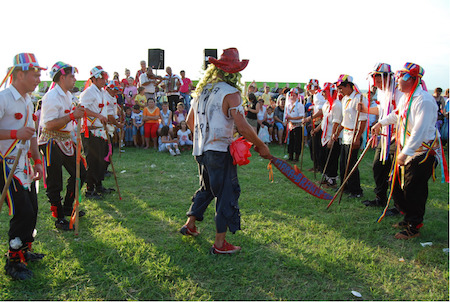
Photo 8. The Căluș team from Braniștea, county Giurgiu, 3.06.2012. The picture of the full team, with Călușari in dancing formation, with Bailiff and Mute, and with musicians at the background, was taken during the contest of dancing and performance skills in between neighbouring villages; hence, the audience. Taken by Ileana Benga.
Adornex Ox
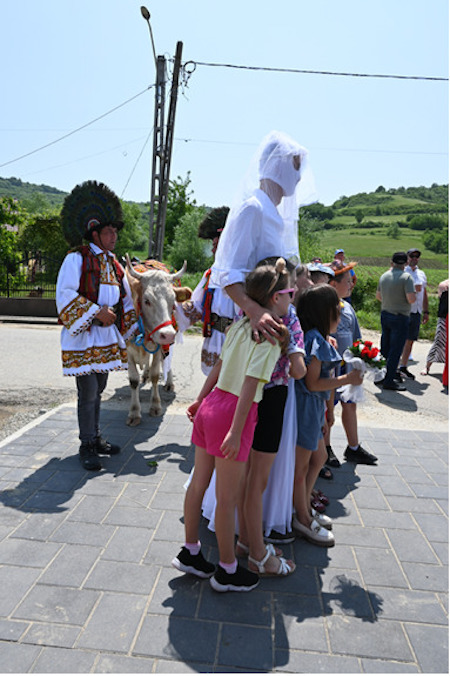
Photo 9. The masked figure of the Bride (the tallest lad, pairing with a short, older, bridegroom) is being photographed with the children party, before the start of the procession, with the “adorned ox” (for want of a true ox, for many a year here they actually adorn a cow) behind them, guarded by the hieratic accompaniers. Pentecost Sunday, 9.06.2025. Taked by Ileana Benga.
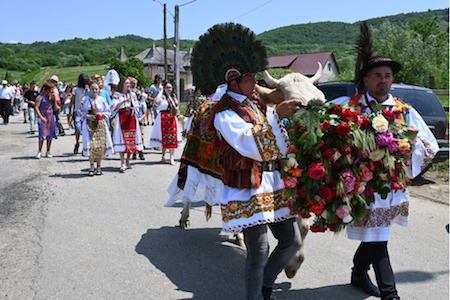
Photo 10. The cortège of the Adorned Ox, in village Căianu Mare, county Bistrița-Năsăud, Pentecost Sunday 9.06.2025. In the procession, first is the cattle with hieratic (and skilful) bearers, then, the hieratic maidens in the feast garment, then the musicians, and only afterwards come the masked figures, mature youth engaging in carnivalesque behaviour. Taked by Ileana Benga.
Notes
1. “The processes of believing that underlie people’s worldviews have been termed creditions (a neologistic term derived from the Latin credere, meaning to believe) (…). Credition is a central brain function that reflects a fundamental human capacity. It interacts with other brain functions, such as perception, reinforcement learning, memory encoding and retrieval, reward/effort computations, and predictive coding of actions” (Angel and Seitz 2024: 1); “the processes of believing lead to a person’s mindset or attitude, which may, nevertheless, change with new information. Importantly, these processes stabilize the individual’s worldview and through predictive coding, determine how the person acts accordingly. However, people may become aware of what they believe, which is a prerequisite for expressing it introspectively as a propositional statement (“I believe…”). Subsequently, it is possible to reason about it, communicate the contents of one’s beliefs to others, and infer from a third-person perspective what other people’s beliefs are likely to be (…). Cognitive feedback is the conscious reflection on what happened. This ex post reflection is in accordance with the argument that humans reason about their thoughts and beliefs (…) in the sense that the conscious explanation can be considered as an elaborate fabrication” (Angel and Seitz 2024: 2).
2. We have received this affirmation as a bewildering first, in village Muncel, Cluj county, on 23rdApril 2023, uttered by a youth participating in the local variant of charivari, on occasion of the celebration of St. George’s day, the local Sângeorz/Gheorghe-cel-verde.
3. This is, in my opinion, the case in village Buru, Cluj county, where two green characters (dressed/covered with foliage, bark, and cinder) embody a male and a female, the male exhibiting a humongous wooden phallus to car-drivers, in the first part of the custom, when they “tax” cars on the main road, away from the main village; while the feminine character, obviously worn by a male, is sweeping the road with a made-up broom, having stopped thus the car from rolling. The male actually is “rewarding” the driver (all the better if there are women in the car, it is said on occasion) for having given some money, when stopped by the sweeping of the female. This is in its entirety, to my opinion, carnivalesque behaviour, contrasting rather saliently with the “job description” of the “modal” Green Man. From Traian Gherman we learn about the taxation of before the times of cars and main roads (document from 1955): the Sângeorz would be surrounded by soldiers/cătanele Sângeorzului, dressed alike among themselves, holding long menacing poles, with bags of cinders at the top, which they would use to “drag”, to force, people to go to the village pub and buy the group of youth (the masked lads) drinks (Gherman 1986: 102). Yet, Bogdan Neagota considers, in a thorough research dedicated to the Green Men (Neagota 2011: 354, note 5), that, given the scarcity of documentation we behold to this day, it is impossible to assert an anteriority for the simpler variants of the Green Man, against the composite types, even though that hypothesis had been fostered by a prior authority on the matter, I. R. Nicola (1982), who divided the extant variants into original/purer, simpler, and syncretic, using a historical-geographical method. Together with Bogdan, I have been researching the Buru variant of the Green Man on St. George’s feast day in 2005, 2009 and 2015, respectively; while colleagues in the Orma Sodalitas Anthropologica have given continuity to the monitoring of this custom, up to the present (2025).
4. The role of the wooden pole in a number of traditional customs is comprehensively treated in G. Comănici 2004; for our purposes, see especially pages 88-90.
5. From the times of Traian Gherman’s field collections, in the interwar period (resulting in a reservoir of 90 localities where the custom Sângeorzul had been documented) to our times (where we met in the field six Sângeorji, a similar number of Green Men/Păpălugăre on occasion of the gathering of the sheep flock, and a number of Green Men/Frunzari agglutinated to other popular customs), the format is a template, being kept and thus transmitted. (cf. Gherman 1986). Yet, the details hold paramount importance in Gherman’s account, for they describe an older mask, in Codor village, Cluj county (Green Men/Goțoi plus Păpălugără/Frunzari– whom we documented in 2005 and 2009), clad in oak tree branches, having a rabbit skin on their head and sheep bells attached to their feet, for the Păpălugără, and in oak leafs on the body and wild cherry-tree helmet, for the Goțoi. This description, extended to other villages –materials to support this evidence are stored in the unpublished archive of Traian Gherman– change rather radically our late intimations about the aspect, and probably functions, as well, of this archaic mask.
6. Of these four villages, three have survived to our times, with somewhat modified versions, and we have been able to document them in plenty with the Orma teams: beginning with 2003 in village Pădureni (when they had stopped for four years the feast of the Pentecost Ox; recently, a purified version made solely of Green Men was revived, witnessed scientifically by Bogdan Neagota in 2022, and by myself in 2023), continued uninterruptedly in Mănăstirea since 2004 (twenty years of documentation), and frequently so in Căianu Mare and Căianu Mic, beginning with 2004. Orma has researched thoroughly all extant variants of the Adorned Ox, in Cluj County (Mănăstirea, Mintiul Gherlei, Batin) and in Bistrița-Năsăud county (Căianu Mic, Căianu Mare, Figa, Tăure) during the interval 2003 – 2024.
7. On Pentecost 2010 Monday, 24th May, Bogdan Neagota began the research of the last documented “taking from the Căluș”, in village Cerăt, Dolj county. The story of the event is stored in his Notes on Cerăt, the călușerească healing, 2010. Subsequent narrative field research has yielded equally important materials and they begin to be published in Neagota 2012, where, on page 56, he is linking the Cerăt healing event to his other two “road to Damascus” scientific moments brought by strenuous research in 2010.
8. In an interesting and compelling ethnography, Deborah Puccio describes a solely feminine involvement in the local carnival maškaroni or maškire of the Slavic minority of Val Resia, in Friuli, caused by the absence of men exiled for work afar or abroad: among the other male tasks assumed by the women at home, there laid the feast celebrations, too. Yet, they would adapt it to the feminine specificities, wearing the specific costumes –which were not mockeries at all, rather, costumes of their foremothers– from the age of first carnival maškire around 15, 16, 17 years of age, to the age of their marriage, when they would stop their own involvement with the custom, to let it on to their younger, unmarried, female relatives (Puccio 2002: 12).
9. Speaking about the “wedding” sketch or screenplay of so many of the carnivalesque dramaturgical settings, H. B. Oprișan,author of an important monography called “Theatre with no stage” (1981: 285) states that: “[the cortège] of the “Wedding” displays in a subtle way a farse: a farse not coarse, nor rude, on the contrary, a refined one. You fail to pin the precise moment when the serious is switched to the grotesque. Actions aren’t profligate, violent, exaggerated and dissolute. Everything is being carried like in a solemn ceremonial”.
10. Many situations of transmission of cultural facts should not be confined, during analysis, to cultural factors; we find very useful at least to offer the alternative –or complementary– view of cognitive evolutionary anthropology and neurosciences: “Administration of OXT [oxytocin] may even modify complex psychological constructs such as self-concept, for instance, by increasing the subjective experience of attachment security in insecurely attached adults (…) or by eliciting stronger positive attitudes toward oneself (…). OXT also influences self-perception of extraversion and openness to new experiences, in the absence of mediation by stress or negative affect” (Hurlemann and others 2017: 32-33).
11. “Our field experience of theCălușled us to interact with many types of informants (…), who, addressed with questions on what is being told of the magical diseases from Whitsunday (Rusalii), and on the thaumaturgical powers of the dance of the călușari, came to tell as well what they were actually believing, for real, or only for the camera/tape recorder. Thereby we are endowed with a large variety of etiological and explanatory discourses, ranging from magic-infused narrative explanations over the binomial luat din Căluș (taken by the Căluș) versus scos din Căluș (taken off the Căluș), up to the science-diffused solutions (a kind of epilepsy, neurosis, self-suggestion etc.), all of them folklorically, orally, imaginatively distorted” (Benga and Neagota 2010: 202 and 210). In the case of the Green Men, the foliage in the costume is highly praised, being a reservoir of precious fertility: it enhances lactation in cows fed with these leaves (Gherman 1986: 99 and 102).
12. “Thus, one possibility is that puritanical norms emerge through random variation, as one of the many equilibria that enforcement mechanisms can maintain, and are then favoured by cultural group selection” (Fitouchi and others 2023: 24).
13. “This may explain why, aside from values of fairness, reciprocity, solidarity or loyalty, many societies develop hedonically restrictive standards of sobriety, asceticism, temperance, modesty, piety, and self-discipline” (Fitouchi and others 2023: 39).
14. Silvia Marin Barutcieff discusses the following saints: Marina, Ecaterina, Evdochia, Varvara, Paraschevi, Lucia, Wilgefortis, Mary Magdalene, Mary of Egipt, Hristofor/Christopher and their bodily mutilations, self-induced in search for the abolition of the body (especially in view of marriage), inflicted by their persecutors, or resulting from arduous prayer to God, as they appear in many iconic representations on church walls all across Romania, and in a number of local legends, contemporary to the author’scollection, or retrieved from 150 years old archives.
Bibliography
Angel, Hans-Ferdinand (and Rüdiger J. Seitz)
2024 “Credition and the neurobiology of belief: the brain function in believing”, Academia Biology, nº 2 (4): 1-5. https://doi.org/10.20935/AcadBiol7359
Benga, Ileana
2005 Tradiţia folclorică şi transmiterea ei orală [The Folkloric Tradition and its Oral Transmission]. Cluj-Napoca, Ecco.
2009 “Dramaturgia aniversară – nod articular în transmiterea tradiţională” [Anniversary Dramaturgy – knotting and re-knotting with tradition. A model of transmission], in Narcisa Ştiucă (coord.), Căluşul – emblemă identitară şi factor de cunoaştere şi armonizare cu alte culturi [The Căluş – Identity Sign and Agent of Knowledge and Harmonization between Cultures]. Bucureșt, Editura Universităţii: 49-65.
2015 “’I’m stabbing you, I’m stabbing you not’. Tales of witches, their gatherings, magic thefts and wrestles around Roşia Montană, România. Towards a modal biography of the local witch type”, in Franco Castelli and others (coord.), Il Canto di Orfeo. Poesia – rito – magia. Atti del XVII Convegno Internazionale (Rocca Grimalda, 22-23 Settembre 2012). Arricia, Aracne editrice: 99-129.
2018 “The Feast of Saint George anf the Mythical Quest for Fertility: Triggers and Opposers in the Romanian Narrative Around the Batttles of Fertility”, in Gordana Blagojević (coord.), The Feast of Saint George: Different Cultural Contexts and Traditions. Belgrade / Novi Sad, Serbian Academy of Sciences and Arts, Artprint Media: 201-215.
Benga, Ileana (and Bogdan Neagota)
2010 “Căluș and Călușari Ceremonial Syntax and Narrative Morphology in the Grammar of the Romanian Căluș”, Archaeus (București), nº XIV: 197-227.
Burke, Peter
1978 Popular Culture in Early Modern Europe. London, Harper Torchbooks.
Comănici, Germina
2004 Ramura verde în spiritualitatea populară [The Green Branch as Symbol in Popular Spirituality]. București, Editura Enciclopedică.
Eliade, Mircea
1949 Mitul eternei reîntoarceri [Cosmos and History]. București, Univers Enciclopedic Gold, 2011.
1973 “Notes on the Căluşari”, Journal of the Ancient Near Eastern Society of Columbia University (New York), nº 5: 115-122.
Fitouchi, L. (and others)
2023 “Moral disciplining: The cognitive and evolutionary foundations of puritanical morality”, Behavioral and Brain Sciences, nº 46, e293. doi:10.1017/S0140525X22002047.
Gervais, M. M. (and D. M. T. Fessler).
2017 “On the deep structure of social affect: Attitudes, emotions, sentiments, and the case of ‘contempt’ ”, Behavioral and Brain Sciences, nº 40, e225. doi:10.1017/S0140525X16000352.
Gherman, Traian
1984-1986 “Sângeorzul sau Bloaja, un obicei agrar la românii din Transilvania” [“The Sângeorz or Bloaja, an Agrarian Custom at the Romanians from Transylvania”], Anuarul de Folclor (Cluj-Napoca), nº V-VII: 89-118.
Hurlemann, R. (and others)
2017 “Oxytocin shapes the priorities and neural representations of attitudes and values”, Behavioral and Brain Sciences, nº 40, e241. doi:10.1017/S0140525X16000807
Lewis, C. S.
1960 Part 3 of “The Four Loves”, written and narrated by C. S. Lewis. https://www.youtube.com/watch?v=YljTz0Kkdvg (retrieved on 21.03.2025), quotation in text at 9:35 minutes.
Marin-Barutcieff, Silvia
2014 “Deformare și vătămare: metamorfoze ale corpului sacru în cultura populară” [Deformation and harm: metamorphoses of the sacred body in the popular culture], in Cornel Bălosu, Nicolae Mihai (coords.). Craiova/Cluj-Napoca, Universitaria/Presa Universitară Clujeană: 53-70.
Neagota, Bogdan
2011 “Ritualità iniziatica e cerimonializzazione calendaristica nelle feste di primavera in Transilvania: l’Uomo Verde. Prospettive etno-antropologiche e storico-religiose” [Initiatory Rituality and Calendric Ceremoniality in Spring Feasts in Transylvania: The Green Man. Ethno-anthropological and historical-religious perpectives], Archaeus (Bucharest), nº XV: 349-378.
2012 “Căzătoare, necromante, vrăjitoare. Experiențe și tehnici arhaice ale extazului în regiunea Dunării de mijloc” [Fallers, Necromancers, Sorceresses. Experiences and Archaic Techniques of Ecstasy in the region of Middle Danube], Orma (Cluj-Napoca), nº 17: 51-98.
2019 “Homo viridis contra strigas. Ethnographic description and historic-religious archaeology in rural Transylvania”, REF/JEF (Bucharest), nº 1-2: 69-93.
Neagota, Bogdan (and others)
2017 “On the substantial contribution of ‘contempt’ as a folk affect concept to the history of the European popular institution of charivari”, Behavioral and Brain Sciences (Cambridge), nº 40, e244: 35-36.
Nicola, Ioan R.
1981-1982 “Un vechi ritual agrar din Transilvania: Boul înstruţat” [“An Ancient Agrarian Ritual from Transylvania: the Adorned Ox”], Marisia (Târgu-Mureş), nº XI-XII: 553-554.
Oprișan, Horia Barbu
1981 Teatru fără scenă [Theatre Without Stage]. București, Meridiane.
Panero García, Maria Pilar
2025 “Pregón de Settimana Santa”, Bercianos de Aliste (Zamora), 12 de abril.
Puccio, Deborah
2002 Masques et dévoilements. Jeux du féminin dans les rituels carnavalesques et nuptiaux [Masks and Unveilings. Feminine plays within carnivalesque and nuptial rituals]. París, CNRS, 2002.
